

Table of Contents
- Start With a Dorm Room Essentials Checklist
- How to Decorate a Dorm on a Budget: 7 Cheap Ideas That Work
- Damage-Free Hanging Methods That Pass Dorm Inspections
- Build Cozy Dorm Room Vibes With Textiles and Lighting
- Shared Space Negotiation: Decorating a Room With a Roommate
- Lighting Safety Rules Every Dorm Room Has to Follow
- Frequently Asked Questions
Last Updated: September 10, 2026
Start With a Dorm Room Essentials Checklist
Learning how to decorate a dorm on a budget starts with one uncomfortable truth: the stuff you actually need is boring, and the stuff you want is where the fun lives. This guide from Caltucky Creations splits the difference. A dorm room essentials checklist is a prioritized list of what to buy, borrow or skip before move-in day, ranked by how often you will actually use each item. Get the boring half right first, and the fun half gets a lot cheaper.

Here is the short version:
| Priority | Buy It | Skip It |
|---|---|---|
| Bedding | Sheets, mattress pad, one comforter | Decorative pillow piles |
| Storage | Under-bed bins, over-door hooks | Freestanding shelving |
| Lighting | One desk lamp, one clip light | Floor lamps |
| Comfort | One cozy blanket, one mug | Matching everything |
| Walls | Damage-free strips, one poster | Frames for every print |
What to Buy First and What to Skip
Buy first: bedding, storage bins, a desk lamp, a power strip with a surge protector, and one blanket that makes the bed feel like yours.
Skip first: anything glass, anything that needs a drill, and anything you would cry about if a roommate knocked it over. Dorm rooms are shared, temporary and occasionally chaotic. Shop accordingly.
How to Decorate a Dorm on a Budget: 7 Cheap Ideas That Work
The fastest way to decorate a dorm on a budget is to spend where you touch and save where you look. Seven moves, ranked by payoff, and yes, every single one of them is something you can carry up three flights of stairs in one trip.
- Thrifted picture frames, mismatched on purpose. Grouping odd frames looks intentional; matching ones look expensive. A cluster of three to five in one corner reads as a gallery wall without the gallery-wall budget.
- A funny graphic tee draped over the desk chair. Instant color, zero installation, and it doubles as the shirt you actually wear to the dining hall. Rotate it weekly and your chair becomes a mood board.
- String lights on a damage-free strip along one wall. Warm light beats overhead light every time. Run them along the top of the headboard or the window frame, not across the ceiling, you want ambiance, not a hostage situation.
- One throw blanket in a loud print. It covers a plain bed, doubles as a wall hanging, and becomes a cape when the heating is "being fixed." A 50" × 60" size is the sweet spot: big enough to actually use, small enough to fold on a shelf.
- A scented candle for the desk. One good scent does more for a room than three posters. Go seasonal, a fall or winter scent makes a beige room feel like a place with opinions.
- A mug that makes you laugh at 7 a.m. Small, cheap, used daily. This is the highest cost-per-use item in the entire room, and it is also the one your roommate will steal.
- A car magnet on the mini fridge. Yes, really. It is the cheapest personality upgrade in the room, it sticks to the fridge door with zero adhesive, and it survives being knocked off a hundred times.
The through-line: buy the thing you will touch every day, and let the thing you only look at be the cheap one. A dorm room does not need to be decorated. It needs to be inhabited, loudly.
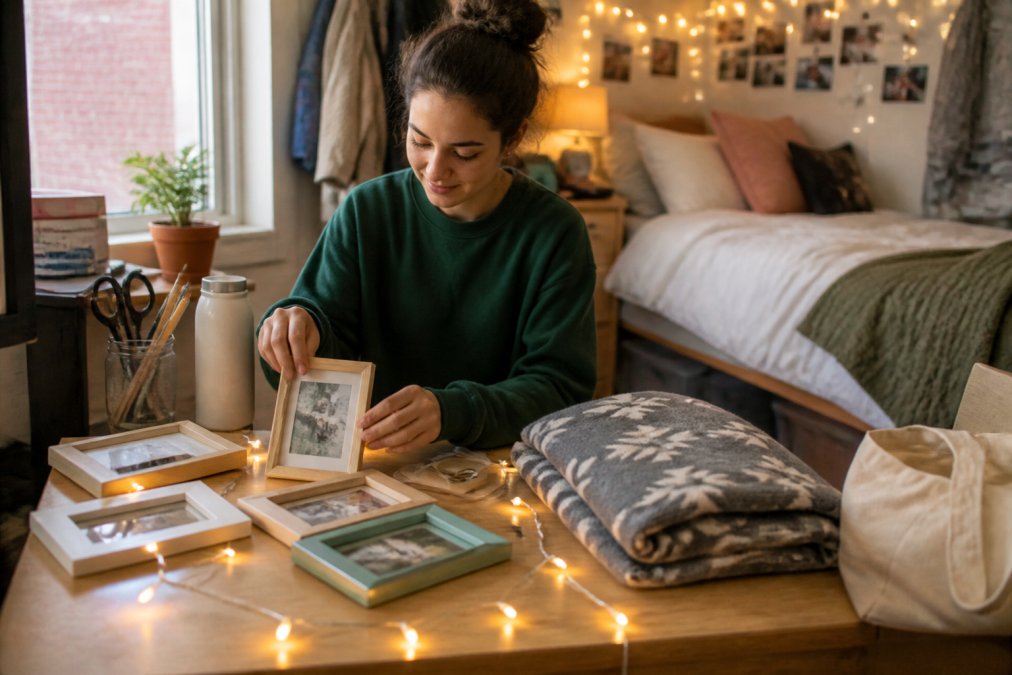
Thrifted Finds and Upcycled Pieces
Thrift stores, estate sales and Buy Nothing groups are where dorm rooms get their character. A used wooden crate becomes a bedside table. An old scarf becomes a wall hanging. A cracked mug becomes a pen cup. A vintage tee that no longer fits becomes a pillow cover if you are feeling crafty and own a needle.
The sustainability angle is real, too. Buying secondhand keeps usable furniture and textiles out of landfills, and campus sustainability offices at many universities run end-of-year donation drives specifically so students can pass items along instead of trashing them. Translation: the stuff you leave behind in May is somebody else's free decor in August.
A few upcycle moves that actually work in a dorm:
- Glass jars from pasta sauce become pen cups, makeup brush holders or a tiny plant pot.
- A wooden crate on its side becomes a shelf; on its top, a nightstand.
- Old t-shirts become throw pillow covers, no sewing machine required if you use a no-sew fabric adhesive.
- A scarf or bandana becomes a wall hanging with two adhesive clips and zero commitment.
The rule of thumb: if it is free and it fits in a tote bag, it is dorm decor. If it needs a drill, it is somebody else's problem.
Damage-Free Hanging Methods That Pass Dorm Inspections
Damage-free hanging is the practice of attaching things to walls using removable adhesive products instead of nails, screws or tape. It matters because most housing contracts charge residents for wall damage at move-out, and paint repair bills add up fast. The good news: almost nothing you want to hang actually requires a hole in the wall. The bad news: most students find that out after they have already made one.
The reliable options, ranked by how much weight they actually hold:
- Removable adhesive strips for posters, lightweight frames and small mirrors. The interlocking kind holds more than the foam kind, and the package tells you the rating.
- Adhesive hooks rated for the weight you are actually hanging, not the weight you hope. A hook rated for a certain load is rated for a clean, smooth, painted surface, not cinder block.
- Tension rods inside a closet or between two surfaces, no adhesive at all. These are the unsung hero of dorm hanging: a tension rod in a window frame holds a curtain, and a tension rod in a closet holds a shoe rack.
- Over-door hooks for towels, bags and lanyards. Zero wall contact, zero risk.
- Magnetic hooks on the mini fridge or a metal bed frame. No adhesive, no residue, no argument.
Read the weight rating on the package and halve it. Adhesive performance drops on painted cinder block, which is what a lot of dorm walls are made of, and it drops further in humidity. A hook that holds a backpack in a dry room may not hold one in August.
Why Adhesive Fails (and How to Stop It)
Adhesive strips fail for three predictable reasons, and all three are preventable:
- The surface is dirty or dusty. Wipe the wall with rubbing alcohol and let it dry completely before you stick anything. This one step prevents most failures.
- The surface is textured. Cinder block, brick and heavily textured paint give adhesive almost nothing to grip. On those walls, switch to tension rods, over-door hooks or magnetic hooks.
- The weight is over the rating. Adhesive does not fail gradually; it fails all at once, usually at 2 a.m., usually loudly.
How to Remove Adhesive Without Losing Your Deposit
Peel adhesive strips straight down, slowly, following the package directions. Ripping them off at an angle is the single most common way students turn a removable hook into a paint repair charge. If a strip resists, warm it with a hair dryer on low for a few seconds to soften the adhesive, then keep pulling straight down. Never use a knife, a credit card or a roommate's ID to scrape it off.
U.S. Consumer Product Safety Commission guidance on seasonal and decorative lighting
Build Cozy Dorm Room Vibes With Textiles and Lighting
Cozy dorm room vibes come from two ingredients: soft things and warm light. Overhead fluorescent lighting makes any room feel like a dentist's waiting room, and bare walls make it feel like a holding cell. Fix both and the room transforms.
Textiles do the heavy lifting. A throw blanket on the bed, a second one over the desk chair, a rug if your floor is bare, a pillow that is decorative rather than functional. Layering textures in two or three colors reads as designed even when it was accidental.
For lighting, aim for three sources instead of one: a desk lamp for tasks, string lights or a clip light for ambiance, and whatever overhead fixture your room came with, used as sparingly as possible. Warm white bulbs, not cool white.
This is where a good blanket earns its keep. The Halloween Candy Ghost Velveteen Microfiber Blanket comes in 40" × 30", 60" × 50" and 80" × 60" sizes, so it works as a lap blanket at the desk or a full bed topper, and the retro spooky ghost design does the decorating for you.
U.S. Consumer Product Safety Commission guidance on seasonal and decorative lighting
Shared Space Negotiation: Decorating a Room With a Roommate
Decorating a room with a roommate works best when you agree on three things before anyone buys anything: a color palette, a lighting plan and a no-surprises rule for shared surfaces.
Try this script at your first conversation:
"I'm thinking warm tones, string lights instead of the overhead, and we each get one wall to do whatever we want. Shared surfaces stay neutral. Deal?"
That gives both of you a guaranteed creative outlet and keeps the middle of the room from becoming a turf war. If your tastes clash badly, split by zone: your half of the desk, your side of the room, your shelf. Nobody has to compromise their entire personality.
Lighting Safety Rules Every Dorm Room Has to Follow
Dorm lighting has real safety rules, and they exist because of fire risk, not because your resident advisor hates fun. Most campus housing policies restrict or ban halogen bulbs, open-flame candles, and daisy-chained extension cords. Some prohibit anything with a heating element.
What that means in practice:
- Use LED bulbs. They run cooler and draw less power.
- Plug string lights into a surge protector, not a daisy chain of extension cords.
- Never run a cord under a rug or across a doorway.
- If candles are banned in your building, a flameless candle or a wax melt gives you the scent without the violation.
Check your own housing agreement for the specific list, since policies vary by campus and by building.
National Fire Protection Association resources on campus and dormitory fire safety
Decorating a dorm on a budget is mostly about knowing which corners to cut and which ones to spend on. Spend on the things you touch daily, save on the things you look at, and let one loud, funny item carry the whole room. Caltucky Creations makes exactly that kind of item: original funny graphic tees, hoodies, scented candles, mugs and cozy blankets designed to do the decorating for you, with soft-style basics that hold up wash after wash. Start with a blanket, add a mug, and let the room develop a sense of humor. Continue shopping at Caltucky Creations and find the piece that makes your dorm feel like yours.
Frequently Asked Questions
What are the best ways to personalize a dorm room without breaking the bank?
Start with items that pull double duty. A funny graphic tee can hang on a wall as art, a cozy blanket doubles as a bed throw and a seat cover, and a mug holds pens on the desk. Thrifted frames, printed photos and string lights cost very little. Focus on one or two statement pieces, like a Halloween-themed velveteen microfiber blanket, then let cheaper basics fill in around them.
How can I make a small dorm room feel cozy and inviting?
Layer soft textiles: a throw blanket on the bed, a small area rug, and a couple of throw pillows. Swap harsh overhead light for string lights or a small lamp with a warm bulb. Keep clutter in bins under the bed. Add one personal item you actually love, like a funny mug or a candle, so the room reads as yours instead of generic campus housing.
What budget-friendly dorm essentials actually add personality?
A graphic tee you can wear or display, a scented candle for mood, a funny mug for late-night coffee, and a cozy blanket are the four that do the most work. Pair them with command hooks for damage-free hanging and a small storage bin. These cover comfort, humor and function without eating your whole budget, and they survive the move-out purge.
How do I balance dorm functionality with my own personal style?
Pick a small color palette, then repeat it in cheap places: bedding, a rug, a blanket. Use storage that looks intentional, like a tote bag on a hook or a basket under the desk. One or two loud, funny pieces, like a retro ghost blanket or a graphic hoodie draped over the chair, give the room personality without fighting the space you actually have to live in.