

Table of Contents
- Start With a Sensory Friendly Halloween Party Plan
- Your Halloween Party Planning Checklist
- Accommodating Sensory Needs at Parties: Costumes, Noise, and Lighting
- Sensory Friendly Halloween Activities for Every Energy Level
- Build a Calm-Down Corner and Sensory Kit
- Budget-Friendly DIY Sensory Decor and Snacks
- Party Etiquette for Neurodivergent Guests and Post-Party Decompression
- Conclusion
- Frequently Asked Questions
Last Updated: October 1, 2026
Start With a Sensory Friendly Halloween Party Plan
A sensory friendly halloween party starts with one rule: comfort beats creepy. Before you buy a single fake cobweb, plan around your guests' needs, not Pinterest's.
Here's the part most guides skip. A sensory friendly Halloween party isn't a watered-down party. It's a better party with the volume knob turned to a setting everyone can live with.
Pick a Guest List and Ask About Triggers
Trigger management begins before the invitations go out. Ask parents one simple question: "Anything we should know about noise, textures, or food?"
Keep the guest list small. Six to eight kids works better than twenty. Fewer bodies means less noise, shorter lines, and more room to move.
Ask about:
- Loud sounds and sudden noises
- Costume textures and tags
- Food allergies and safe snacks
- Crowds and personal space
- Lights, especially flashing ones
Write the answers down. You'll use them in every decision that follows.
Your Halloween Party Planning Checklist
A visual schedule is just a simple picture list of what happens when. Kids can point to it instead of asking. It builds predictability, which lowers anticipatory anxiety before the party even starts.
Accommodating Sensory Needs at Parties: Costumes, Noise, and Lighting
Accommodating sensory needs at parties comes down to three things: what guests wear, what they hear, and what they see. Get those right and the rest mostly handles itself.
Costume Comfort That Doesn't Itch
Costume comfort matters more than costume accuracy. A kid in an itchy, scratchy outfit will be miserable by minute ten.
Offer these options:
- Soft cotton basics instead of stiff polyester
- Loose fits over tight spandex
- No masks; face paint only if they ask
- Tag-free shirts and hoodies
- Layers they can peel off when they overheat
Tactile sensitivity is real. Let kids wear a familiar hoodie over their costume and call it a costume. Problem solved.
Managing Noise, Strobe Lights, and Fog Machines
Skip the strobe lights and fog machines entirely. Both are common triggers, and neither adds much beyond a headache.
Instead:
- Keep music at a low volume
- Use warm lamps instead of overhead lights
- Set up a quiet room with the door closed
- Offer noise-canceling headphones
- Warn guests before any loud moment, like a group countdown
Auditory stimulation builds up over an evening. A kid who seems fine at 6 p.m. may be done by 7. Watch for the signs and let them step out.
Sensory Friendly Halloween Activities for Every Energy Level
The best sensory friendly halloween activities give kids a choice between busy and calm. Run both tracks at once so nobody has to opt out of the fun.
High-energy options:
- Costume parade around the yard
- Pin the smile on the pumpkin
- Freeze dance with a soft playlist
Quiet Alternatives to Traditional Party Games
Quiet alternatives work just as well, and some kids will pick them every time.
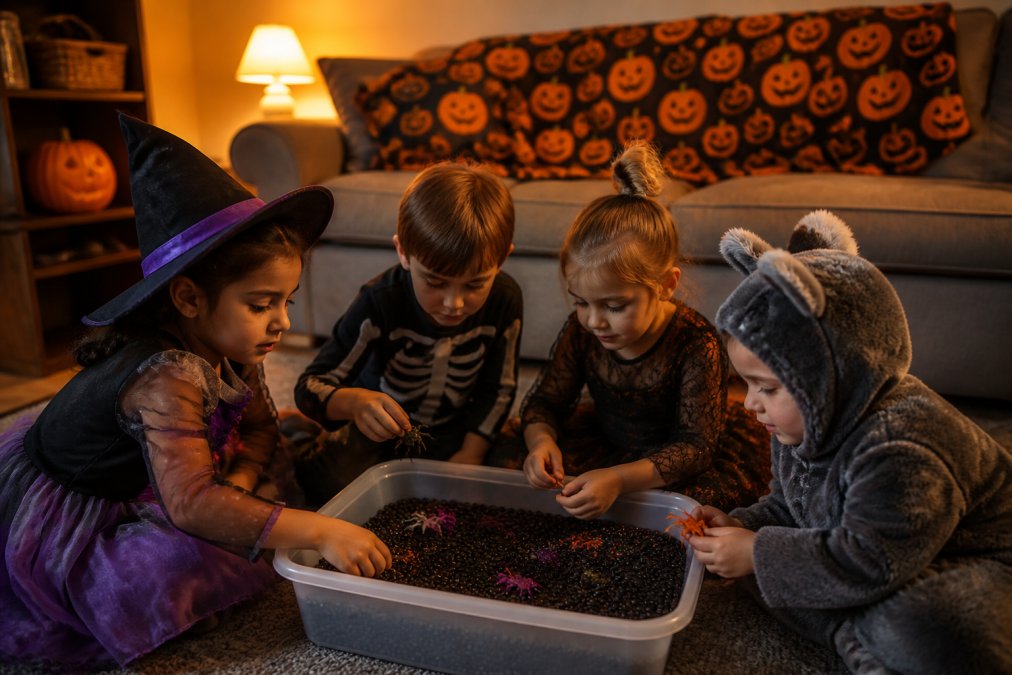
- Sensory bins filled with dry beans and plastic spiders
- Felt board stories
- Coloring pages at a low table
- A "wrap the mummy" game with toilet paper
- Story time with a flashlight
Structured activities beat free-for-alls. When kids know what's next, they settle faster and meltdowns drop.
Build a Calm-Down Corner and Sensory Kit
A calm-down corner is a small, quiet space a guest can retreat to without asking permission. It should sit away from the noise, with soft light and no traffic.
Stock it with:
Halloween Pumpkin Field Snuggle Blanket →
- A beanbag or floor cushion
- A cozy blanket
- Noise-canceling headphones
- A few fidget toys
- A water bottle
Pair the corner with a sensory kit you can hand to any guest who needs it. Keep it in a tote by the door.
A good sensory kit includes headphones, sunglasses, a fidget, a soft blanket square, and a snack. Comfort items do the heavy lifting here.
For the blanket, a hooded throw works well because kids can wear it like a cape. The Halloween Pumpkin Field Snuggle Blanket has elastic hand straps so hands stay free for candy. It comes in microfleece or plush sherpa, which matters when a kid wants weight without heat.

Budget-Friendly DIY Sensory Decor and Snacks
Most guides tell you to "keep decor simple" and then send you to a big-box store. Here's the gap they miss: the cheapest sensory-friendly decor is the stuff you make, because you control the texture, the smell, and the noise level. No animatronic screaming doorbell required. Ever.
DIY Decor That Won't Ambush Anyone
A note on scent: scented candles and plug-ins are a common trigger. If you want a candle burning, keep it in a room guests aren't using, or pick something mild and food-adjacent rather than heavy floral. A pumpkin-spice or vanilla candle on a kitchen counter, well away from the party zone, gives you the vibe without the headache.
Snacks That Don't Require a Background Check
Sensory-friendly food usually means plain, predictable, and easy to identify. Label everything, including the water. Kids with food anxiety relax when they can see exactly what they're getting.
- Mini pumpkin muffins (one bowl, no frosting)
- Cheese cubes and plain crackers
- Apple slices with no dip
- Plain popcorn in small paper cups
- Water bottles and juice boxes, labeled
The Merch Table (Yes, Really)
Here's the fun part. A sensory-friendly party is a great excuse to hand out soft, funny merch instead of plastic junk that ends up in a landfill by November 1. A graphic tee or a cozy hoodie doubles as a costume layer and a comfort object. A mug works as a party favor for the grown-ups who stayed to help. And a blanket is basically a portable calm-down corner.
If you want the easy version, our Halloween Pumpkin Field Snuggle Blanket has elastic hand straps so hands stay free for candy, and it comes in microfleece or plush sherpa. Soft, funny, and it does the heavy lifting so you don't have to.
Party Etiquette for Neurodivergent Guests and Post-Party Decompression
Two things almost every guide skips: how to brief the other kids and parents before they walk in, and what to do after everyone leaves. Both matter more than the party itself.
Briefing Neurotypical Guests Before They Arrive
At the party, the etiquette is simple:
- No jump scares, no fake blood, no screaming props
- No touching without asking, costumes included
- Quiet voices near the calm-down corner
- If someone leaves a game, let them leave without comment
- Don't ask why someone is wearing headphones. Just don't.
Reading the Room Before It Reads You
Auditory and social stimulation build up over an evening. A kid who seems fine at 6 p.m. may be done by 7. Watch for the early signs: covering ears, going quiet, pacing, asking repeatedly what's next, or getting clingy with a parent. Those are exit ramps, not misbehavior.
When you see them, offer a low-key out. "Want to go check on the blanket fort?" works better than "Do you need a break?" because it doesn't require the kid to admit anything.
Post-Party Decompression: The Part Nobody Plans For
Inclusive celebration isn't about lowering the bar. It's about building a party where every guest can actually reach it, and then letting everyone, host included, recover in peace. Our Candy Grabber Ghost blanket and Three Ghosts Trick-or-Treat throw are soft, funny, and happy to do nothing but exist while you do the same.


Conclusion
Caltucky Creations makes the cozy part easy. Our Candy Grabber Ghost blanket and Three Ghosts Trick-or-Treat throw are soft, funny, and built for exactly this kind of wind-down.
Get started with Caltucky Creations and make your cozy nights the best part of the night.
Frequently Asked Questions
What are some sensory friendly Halloween activities?
Go for low-pressure options: a sensory bin filled with dry beans and plastic spiders, a glow-stick bath, cookie decorating with soft frosting, or a quiet Halloween movie with subtitles. Skip anything with sudden loud noises, strobe lights, or forced physical contact. Having two or three activity stations lets guests rotate when they need a break instead of sitting through one long game.
How do I make a Halloween party less overwhelming for neurodivergent guests?
Cut the sensory load before guests arrive. Swap strobe lights and fog machines for warm lamps, keep music at a conversational volume, and set up a calm-down corner with noise-canceling headphones and a comfort item. Send a simple social story or schedule ahead of time so nobody walks into surprises. Predictability does more for a sensory friendly Halloween than any single decoration.
What are the best sensory-friendly Halloween snacks?
Stick to predictable textures and easy-to-eat bites: plain popcorn, pretzels, cheese cubes, apple slices, and a couple of safe favorites you already know your guests like. Avoid sticky, stringy, or strongly scented foods that can trigger tactile or smell sensitivities. Label everything clearly so guests with dietary needs can self-select without asking, and keep drinks in cups with lids to reduce spills and noise.
How do I communicate sensory expectations to party guests?
Send a short note or text a few days before: mention the noise level, whether costumes are required, what food will be served, and where the calm-down corner will be. Include a simple visual schedule for younger guests showing the order of events. This kind of heads-up reduces anticipatory anxiety and helps parents prepare their kids, so everyone arrives knowing what to expect.