

Table of Contents
- Step 1: Start With Luxury Home Decor on a Budget
- Step 2: Upgrade Hardware and Fixtures for an Instant High-End Aesthetic
- Step 3: Use Paint, Color Palettes, and Architectural Details to Make Your Home Look Expensive
- Step 4: Master Textile Layering Techniques and Oversized Rugs
- Step 5: Designer Secrets for Expensive Looking Homes, Scale, Art, and Greenery
- Step 6: Cheap Ways to Make Your House Look Fancy With Scent and Sensory Design
- Step 7: DIY Luxury Home Decor With Smart Home Integration and Curb Appeal
- Common Mistakes That Make a Home Look Cheap (and How to Make Your Home Look Expensive Instead)
Last Updated: August 2, 2026
The most effective way to learn how to make home look expensive has nothing to do with buying new furniture. This guide breaks down the exact design principles that separate a curated, high-end space from a room that just looks assembled. A home looks expensive when it feels intentional, not when it's filled with costly items. Below, we'll show you exactly how to achieve that intentional quality across every room, using upgrades that range from free to surprisingly affordable.
The real variables are proportion, light, and negative space. Nail those three, and even modestly priced pieces read as curated. Miss them, and a room full of high-end items still looks cluttered and random.
Step 1: Start With Luxury Home Decor on a Budget
Luxury home decor on a budget is achievable when you prioritize editing over adding. The single most impactful thing you can do before spending any money is remove what doesn't belong. Decluttering is the foundation of every high-end interior: designers consistently describe the luxury aesthetic as one of intentional restraint, where every visible object earns its place.
Clear surfaces first. Store items that don't contribute to the room's focal point. Then assess what remains.
From there, budget-friendly upgrades follow a clear priority order:
- Paint (highest ROI per dollar spent)
- Hardware on cabinets and doors
- Lighting fixtures and bulbs
- Textiles and rugs
- Greenery and plants
- Art and statement pieces
Start at the top of that list and work down. Paint transforms a room's perceived quality more than almost any other single change, and it costs a fraction of new furniture.
Step 2: Upgrade Hardware and Fixtures for an Instant High-End Aesthetic
Swapping out hardware is the most underrated upgrade in interior design. Small metal details function as the jewelry of a room: they're noticed subconsciously even when guests can't identify what changed.
Cabinet and Door Hardware
Cabinet and door hardware upgrades deliver outsized visual impact because hardware is touched and seen at close range daily. The finish matters more than the style. Brushed brass, matte black, and unlacquered bronze all read as intentional and current. Shiny chrome and builder-grade satin nickel read as default.
Pick one metal finish and repeat it across cabinet pulls, door hinges, faucets, and light switch plates within the same room. Consistency signals bespoke attention to detail.
Lighting Fixtures and Bulbs
Lighting is where most homes quietly announce their budget. Builder-grade flush-mount ceiling lights are the single biggest giveaway of a space that hasn't been designed. Replacing even one fixture per room, starting with the most visible, transforms the ambient lighting quality immediately.
Bulb temperature matters enormously. Warm white bulbs in the 2700K-3000K range create the soft, layered ambient lighting associated with high-end hospitality spaces. Cool white or daylight bulbs above 4000K create flat, institutional light. According to the U.S. Department of Energy's guide to residential lighting, bulb color temperature is one of the most significant factors affecting how a room feels to occupants.
Step 3: Use Paint, Color Palettes, and Architectural Details to Make Your Home Look Expensive
Paint is the closest thing to a design cheat code. A well-chosen color palette applied consistently across a room signals designer-level intention, and it costs less than almost any other upgrade on this list.
Neutral Tones, Accent Walls, and Trim Work
Neutral tones dominate high-end interiors because they function as a backdrop that makes every other element in the room look considered. Warm whites, greiges, soft taupes, and deep charcoals all read as sophisticated when applied with clean edges and proper prep.
The accent wall approach works best when the wall chosen is the room's natural focal point, typically the wall behind a bed headboard, a fireplace surround, or the wall a sofa faces. Painting it a deeper tone from the same color family creates depth without visual chaos.
Bright white trim against a warm-toned wall creates the crisp contrast that defines the high-end look. If the trim color matches the wall, the room loses its architectural definition entirely.
Adding Molding and Architectural Details
Architectural details are the fastest way to add the bespoke quality associated with older, higher-value homes. Crown molding, picture rail molding, board-and-batten paneling, and wainscoting all add visual weight and vertical interest that paint alone can't achieve.
Peel-and-stick molding products and lightweight MDF trim have made these upgrades genuinely accessible for renters and first-time homeowners. Molding that's too thin for the ceiling height looks decorative rather than architectural. Crown molding height should be roughly proportional to ceiling height, with taller ceilings requiring deeper profiles.
Step 4: Master Textile Layering Techniques and Oversized Rugs
Textile layering is the design technique that separates rooms that look "done" from rooms that look "styled." Multiple textures at different scales create the visual richness associated with high-end interiors.
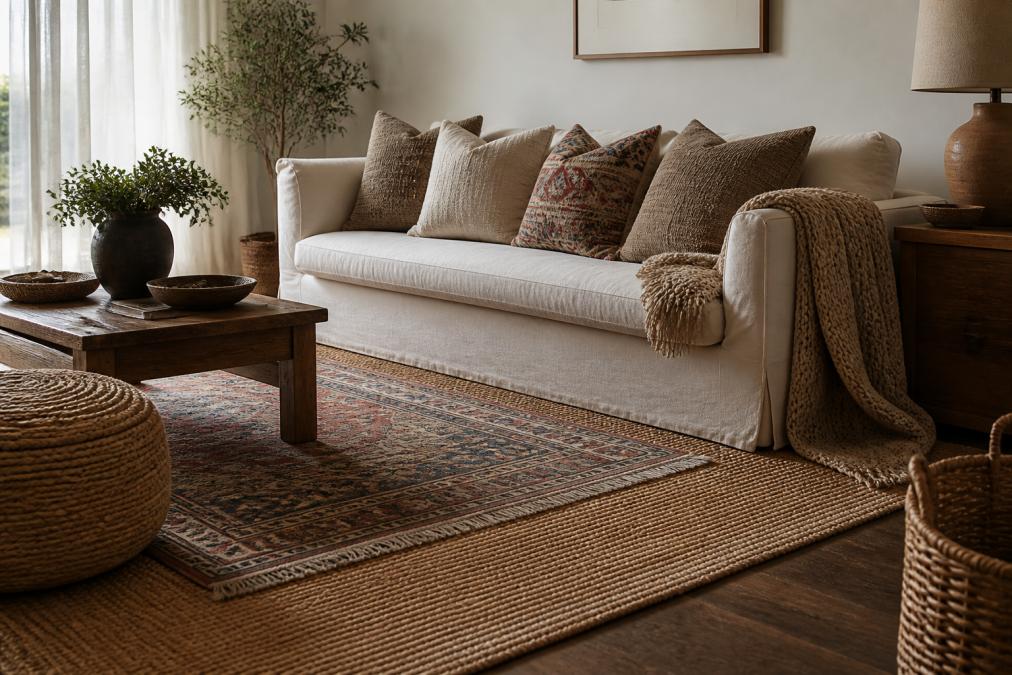
Start with the rug. The most common mistake: buying a rug that's too small. A rug that only sits under the coffee table, with sofa legs floating off the edge, makes a room look smaller and more budget-constrained than no rug at all. The front legs of all seating should sit on the rug at minimum.
Layer textural contrast across the textiles in the room:
- Base layer: A solid or subtly textured rug in a neutral tone
- Second layer: A smaller patterned throw rug or sheepskin layered on top
- Upholstery: Linen, boucle, or velvet on seating pieces
- Cushions: Mix at least three different textures (e.g., woven, embroidered, smooth)
- Throw blanket: Chunky knit or waffle-weave draped asymmetrically over an armrest
Window treatments complete the textile picture. Floor-to-ceiling curtains hung close to the ceiling, even in rooms with standard 8-foot ceilings, create the illusion of height and make windows look architecturally significant.
Step 5: Designer Secrets for Expensive Looking Homes, Scale, Art, and Greenery
What separates a professionally designed room from a well-intentioned DIY space is usually scale and proportion. Designers think about the visual weight of every object and how it relates to the objects around it.
Choosing Large-Scale Wall Art and Statement Pieces
Large-scale wall art is one of the most reliable designer secrets for expensive looking homes. A single oversized piece, hung correctly, anchors a room and creates an immediate focal point.
The sizing rule: art above a sofa should be roughly two-thirds the width of the sofa. Art above a bed should be at least as wide as the headboard. The center of the artwork should sit at approximately eye level, around 57 to 60 inches from the floor, which is the standard used by most art galleries.
A statement piece doesn't have to be expensive. Oversized canvas prints, vintage architectural drawings, and large-format photography all deliver the same scale impact at a fraction of gallery prices.
Incorporating Statement Greenery and Plants
Statement greenery adds the organic, lived-in quality that distinguishes a home from a showroom. Large-scale plants with architectural form like fiddle-leaf figs, birds of paradise, or olive trees function as sculptural elements that add height, texture, and life to a corner.
Scale the plant to the room, not to a pot on a shelf. A plant that reaches the ceiling in a corner with tall ceilings reads as intentional and dramatic. According to research from the American Society for Horticultural Science, indoor plants also measurably improve air quality and occupant wellbeing, making them one of the few decor choices with both aesthetic and functional benefits.
Step 6: Cheap Ways to Make Your House Look Fancy With Scent and Sensory Design
Scent is the most overlooked element in residential design, and it's one of the cheapest ways to make your house look fancy. High-end hotels use signature scent systems because scent creates an immediate, subconscious quality signal that visual design alone cannot.
For scent, the approach is layered and subtle:
- Base: A consistently clean smell, achieved through regular maintenance and good ventilation
- Mid layer: A diffuser with a single, simple fragrance note (cedar, sandalwood, linen)
- Accent: Candles used selectively in social spaces, not every room simultaneously
One fragrance family throughout the home reads as curated. Three different candles in three different rooms reads as a candle store.
Sensory design also includes tactile quality. High-thread-count linens, weighted blankets, and plush bath towels create the physical sensation of luxury that reinforces what the eye sees. These are among the most practical DIY luxury home decor investments because they're used daily.
Step 7: DIY Luxury Home Decor With Smart Home Integration and Curb Appeal
The final category covers two areas that most decorating guides ignore entirely: what happens before a guest walks through the door, and what happens when they interact with the home's systems.
Improving Curb Appeal and Your Entryway
Curb appeal sets the expectation for everything inside. A well-maintained exterior, consistent paint color, and a considered entryway create the first impression that primes a guest to perceive the interior as high-quality.
A few high-impact entryway upgrades:
- Replace the front door hardware with a finish that matches the interior hardware
- Add a console table with a mirror above it to create depth and light
- Place a single large plant or architectural object rather than multiple small decorative items
- Ensure the entryway is well-lit, with warm-toned bulbs that welcome rather than interrogate
A clear sightline from the entryway into the main living area, toward a fireplace, large piece of art, or well-styled bookshelf, creates an immediate positive impression.
Digital and Smart Home Touches That Signal Quality
Smart home integration reads as a quality signal to a growing segment of guests and buyers. According to the National Association of Realtors' home technology report, smart home features are increasingly cited as desirable by home buyers, and they contribute to perceived value beyond their functional benefit.
The upgrades with the highest perceived-quality return:
- Smart lighting with scene control (warm dimmed settings for evenings)
- A smart thermostat with a clean, minimal display
- Hidden cable management for entertainment systems
- Wireless charging surfaces integrated into nightstands or desks
Most are weekend installations. The collective effect is a home that feels considered at every level of interaction.
Common Mistakes That Make a Home Look Cheap (and How to Make Your Home Look Expensive Instead)
Understanding what undermines the expensive look is as valuable as knowing what creates it.
| Common Mistake | Why It Reads as Cheap | The Fix |
|---|---|---|
| Rug too small for the room | Makes space feel smaller, looks like an afterthought | Size up: front legs of all seating on the rug |
| Mixed metal finishes (accidental) | Reads as unplanned, not curated | Choose one finish, apply it consistently |
| Curtains hung at window frame height | Shortens the room, makes windows look small | Hang rods near the ceiling, let curtains pool slightly |
| Cool-white bulbs throughout | Creates flat, institutional light | Switch to warm white 2700K-3000K bulbs |
| Art hung too high | Disconnects art from furniture, looks floating | Center at 57-60 inches from floor |
| Visible cable clutter | Immediately signals low attention to detail | Use cable management or wireless alternatives |
| Too many small decorative objects | Creates visual noise, reads as cluttered | Edit to fewer, larger, more intentional pieces |
| Matching furniture sets | Looks like a showroom floor, not a curated home | Mix pieces from different sources and eras |
The throughline across every mistake: they all signal a lack of intention. The home that looks expensive is the home where every visible decision appears to have been made deliberately.
Matching furniture sets are the fastest way to make a home look like a showroom floor rather than a lived-in, curated space. The real luxury look comes from mixing: a vintage piece alongside a contemporary one, a handmade textile next to a clean-lined modern sofa.
Caltucky Creations offers a curated selection of home essentials, including unique decor and cozy textiles, designed to add the kind of character and flair that makes a space feel genuinely personal rather than assembled. For further guidance on design principles that inform the expensive-looking home, the American Society of Interior Designers' resources for homeowners offer practical frameworks rooted in professional practice.
Getting the expensive look right takes more editing than buying. The biggest obstacle isn't budget; it's the habit of adding before subtracting. Work through these steps in order, and the cumulative effect compounds quickly. Continue shopping to find the pieces that complete your space.
Frequently Asked Questions
What makes a house look luxurious?
A home feels luxurious when it has consistent design choices, not expensive ones. Key factors include a cohesive color palette, quality-looking finishings like trim work and hardware, intentional lighting with ambient and accent layers, and a clutter-free spatial flow. Scale and proportion matter too, oversized rugs, floor-to-ceiling curtains, and appropriately sized art all signal a curated, high-end aesthetic without requiring a large budget.
How can I make my house look expensive on a budget?
To make your home look expensive on a budget, focus on high-impact, low-cost upgrades first: swap out cabinet hardware, add crown molding or picture rail trim, hang floor-to-ceiling curtains, and choose a neutral color palette with one bold accent wall. Luxury home decor on a budget is about editing ruthlessly, decluttering alone transforms a space. Layered textiles, statement greenery, and well-placed lighting do the rest.
What colors make a house look expensive?
Neutral tones like warm whites, soft greiges, deep charcoals, and earthy taupes consistently read as upscale because they create a calm, cohesive backdrop. Deep jewel tones, navy, forest green, or burgundy, work well as accent wall colors and add visual weight without feeling busy. The key is limiting your palette to two or three shades per room so the space feels intentional rather than cluttered.
What small changes make a big difference in home decor?
Swapping builder-grade light switch plates and outlet covers, replacing hollow-core interior doors, adding window treatments that hang close to the ceiling, and grouping decor in odd numbers are all small changes with outsized visual impact. Scent is often overlooked, a signature candle or diffuser tied to a consistent fragrance makes a home feel curated and memorable. These DIY luxury home decor moves cost little but shift the entire feel of a room.
How do interior designers make homes look expensive?
Interior designers rely on a handful of repeatable designer secrets for expensive-looking homes: they always hang art at the correct eye-level height, choose rugs that are larger than most people expect, repeat one metallic finish across hardware and fixtures for cohesion, and mix textures, linen, velvet, wood, and metal, to create depth. They also edit aggressively, removing anything that doesn't serve the room's focal point or overall spatial flow.
Does smart home technology make a home look more expensive?
Yes, when done cleanly. Smart lighting systems that allow dimming and color temperature control add an instant high-end feel without major renovation. Smart thermostats with sleek displays, hidden cable management, and wireless charging furniture inserts all signal quality. The trick is choosing devices with minimal, design-forward interfaces so the technology blends into the decor rather than cluttering it with wires and mismatched gadgets.
This article was written using GrandRanker