

Table of Contents
- Why a Tidy Desk Actually Matters (Beyond Your Mom's Nagging)
- Desk Organization Hacks for Students That Actually Stick
- Best Desk Organizers for Small Spaces (No Furniture Required)
- How to Declutter a Study Area (And Keep It That Way)
- Organization for Neurodivergent Brains (Because One-Size-Fits-None)
- Budget-Friendly DIY vs. Store-Bought Organizers
- Ergonomic Setup That Doesn't Wreck Your Spine
- Frequently Asked Questions
Last Updated: September 3, 2026
Organize a Small Student Desk: Space-Smart Tips
A cluttered desk kills productivity. When your workspace is buried under papers, cables, and mystery items, finding what you need takes longer than actually doing the work. Even a tiny desk can become functional and efficient with the right organization strategy. This guide covers practical desk organization hacks for students that actually stick, from vertical storage to cable management that won't make you want to flip your desk over.
Whether you're studying in a dorm room the size of a closet or working from a bedroom corner, these tips will help you organize a small student desk without a furniture overhaul.
Why a Tidy Desk Actually Matters (Beyond Your Mom's Nagging)
Your desk is ground zero for productivity. When everything has a place, you spend less time hunting for your favorite pen and more time actually getting work done. A disorganized workspace creates mental friction; every search burns energy that could go toward studying.
Research shows that physical clutter directly impacts focus and decision-making. A messy desk forces your brain to process visual noise, draining cognitive resources. Students with organized workspaces report fewer distractions and better concentration. Beyond the mental benefits, a tidy desk protects your stuff, properly stored items are less likely to get lost or damaged.
There's also a psychological component: a clean desk signals to your brain that you're ready to work. Many students find that spending five minutes organizing before a study session actually saves them 20 minutes of distracted browsing later.
Desk Organization Hacks for Students That Actually Stick
The key to desk organization isn't buying expensive systems; it's understanding how you actually use your space. Most students fail because they force themselves into systems that don't match their workflow.
Maximize Vertical Space First
Your desk's surface area is limited, but your vertical space is practically unlimited. This is where most students leave clutter on their desk.
Install floating shelves above your desk if possible. If not, a tall, narrow bookshelf beside or behind your desk works just as well. These shelves should hold reference books, completed assignments, and items you need occasionally but not constantly.
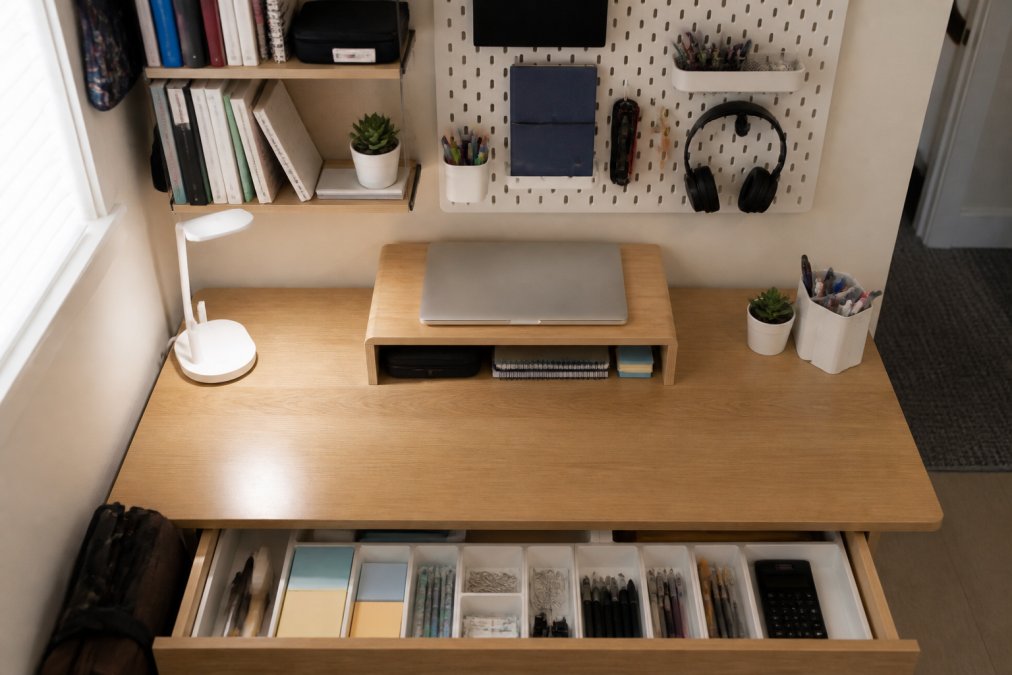
Invest in a monitor riser or desk shelf. This elevates your screen to eye level (better for your neck) and creates storage space underneath for keyboard, mouse, or a filing system. This single move reclaims 15-20% of your desk surface.
Pegboards are underrated desk organizers for small spaces. Mount one on the wall next to your desk and use hooks to hang headphones, charging cables, or frequently used items. Everything stays visible and within arm's reach without cluttering your desktop.
Set Up a Drawer Organization System
Drawers are where organization goes to die without a system. Start with drawer dividers and assign each a category: pens and markers, charging cables, notepads, sticky notes, headphones, and miscellaneous.
Label everything. This prevents the "I'll remember where this goes" lie that leads to chaos within a week. Use a label maker or masking tape. Specificity matters, "cables" is less helpful than "phone chargers" or "USB cables."
For small items that migrate around, use tiered organizers or small containers within your drawer. Review your drawer system monthly and remove unused items to prevent drawer creep.
Tame Your Cable Management
Cables tangle, hide things, and somehow multiply. Cable chaos is also a fire hazard and makes cleaning harder.
Use cable clips or velcro cable ties to bundle cables together and secure them to the back or underside of your desk. Group cables by device: all phone-related cables together, all computer cables together. Label each cable at both ends if you have multiple similar-looking ones.
Consider a cable management box, a simple plastic container that sits under or behind your desk and corrals power strips, excess cable, and chargers. Under-desk cable trays are another option if you have budget; they mount to the underside of your desk and hold cables and power strips out of sight.
Best Desk Organizers for Small Spaces (No Furniture Required)
You don't need to buy a new desk to organize a small student desk. Strategic accessories do the heavy lifting.
Monitor Risers and Under-Desk Storage
A monitor riser solves two problems: ergonomics and storage. By elevating your screen to eye level, you reduce neck strain during long study sessions. The space underneath becomes prime real estate for storing a keyboard, filing system, or supplies.
Under-desk storage solutions like hanging shelves or sliding drawers maximize dead space beneath your desk. These are particularly useful for storing textbooks or completed assignments while keeping your desktop clear.
Desktop Accessories That Earn Their Real Estate
Not every item deserves a place on your desk. The rule: if it's not something you use at least three times a week, it doesn't live on your desktop.
Desk organizers should be functional, not decorative. A pen holder is useful; a decorative pen holder that's too small to hold pens is just taking up space. Cable management boxes, desktop file organizers, and small shelves are the real MVPs of small desk organization.
How to Declutter a Study Area (And Keep It That Way)
Organization is a one-time project; maintaining it is a habit. The difference between a desk that stays organized and one that doesn't is a maintenance routine.
The Daily 5-Minute Reset Routine
Spend five minutes at the end of each study session resetting your desk:
- Return items to their designated homes.
- Wipe down your desk surface with a cloth.
- Clear your desktop of anything that doesn't belong.
- Check your monitor and keyboard for dust.
This isn't a deep clean; it's maintenance. Five minutes of daily maintenance prevents the need for a two-hour reorganization session every month.
Digital vs. Physical Clutter Balance
A cluttered physical desk is obvious, but digital clutter is just as damaging to productivity. Your computer desktop, email inbox, and file folders deserve the same organizational attention.
Create a folder structure on your computer that mirrors your physical organization. Use clear naming conventions: "2026 Fall Semester > Biology > Assignments > Completed" is more useful than "Stuff > School > Bio."
Your email inbox shouldn't be a filing system. Archive or delete emails regularly and use folders for different classes or projects. An overflowing inbox creates the same mental friction as a cluttered desk.
Organization for Neurodivergent Brains (Because One-Size-Fits-None)
Standard organization advice doesn't work for everyone. If you're neurodivergent, conventional systems might feel restrictive or not match how your brain actually works.
For ADHD brains, visibility is often more important than hidden storage. Open shelving, clear containers, and pegboards might work better than closed drawers. Label everything with color coding or visual cues.
For autism spectrum folks, consistency and predictability matter. Once you establish your system, keep it exactly the same. Changes require adjustment time.
If you struggle with executive function, build friction-free pathways. The easier it is to put something away, the more likely you'll actually do it. This might mean having an "inbox" tray for items that haven't been sorted yet.
Some neurodivergent students find that having duplicate items in different locations reduces friction. Keeping a pen in your bag, one at your desk, and one in your backpack means you always have one available.
Budget-Friendly DIY vs. Store-Bought Organizers
You don't need to spend a lot of money to organize a small student desk. The most expensive system isn't necessarily the best one.
Store-bought organizers offer convenience and aesthetics but are typically more expensive and may not fit your specific needs. DIY solutions are often cheaper and more customizable. Repurpose containers from around your home: mason jars hold pens, small boxes organize cables, and old mugs can hold markers.
A hybrid approach often works best: use affordable store-bought items for things that need to be durable (cable clips, drawer dividers) and DIY solutions for specialty storage. The best organizer is the one you'll actually use.
Ergonomic Setup That Doesn't Wreck Your Spine
Organization isn't just about finding things; it's about setting up your desk so your body doesn't pay the price for hours of studying.
Your monitor should be at eye level when sitting with your back straight. Your keyboard and mouse should be at elbow height with arms at roughly 90 degrees when typing. Your chair matters more than people think, invest in one with proper back support if you're studying for hours.
Position your desk near a window for natural light and add a desk lamp for focused task lighting. Avoid glare on your screen by positioning your monitor perpendicular to windows.
Take breaks every 30-60 minutes. Stand up, stretch, and look away from your screen to prevent repetitive strain injuries. An organized desk supports ergonomic setup because it eliminates the need to reach awkwardly for things.
A small student desk can be just as functional as a sprawling workspace with smarter organization. Start with vertical storage, implement a drawer system, manage your cables, and commit to a daily reset routine. The goal isn't perfection; it's creating a space where you can focus on studying instead of hunting for your pen.
If you're looking for a little extra motivation to keep that desk organized, grab a funny mug from Caltucky Creations, like the Bold Blue 'Vacuous' Coffee Mug, as your perfect desk companion. A little humor goes a long way when you're staring at textbooks.

Frequently Asked Questions
What's the best way to organize a small desk when you don't have much space?
Start by maximizing vertical space with shelves or risers, then use drawer dividers to compartmentalize supplies. Cable management clips keep cords from eating real estate. Group items by category (writing supplies, tech, reference materials) so you know exactly where everything lives. The goal is accessibility without visual chaos, every item should have a designated spot.
How can desk organization hacks for students help with focus and productivity?
A clutter-free desk reduces cognitive load. Your brain isn't constantly scanning for that one pen or wrestling with tangled cables. When supplies are labeled and compartmentalized, you spend less time hunting and more time studying. Neurodivergent students especially benefit from visual cues and consistent organization systems that create predictable workflow patterns.
What are the best desk organizers for small spaces that won't break the budget?
Mason jars, repurposed containers, and cardboard dividers cost almost nothing and work surprisingly well. Store-bought options like stackable drawer organizers, monitor risers with built-in storage, and desktop shelves offer better durability if you want to invest. The key is choosing organizers that match your actual desk dimensions, oversized products waste the little space you have.
How often should I declutter my study area to keep it organized?
A daily 5-minute reset before bed or after study sessions prevents buildup. Once a month, do a deeper sort: toss broken pens, file old notes, and reassess your organization system. Many students find that weekly inventory, checking that items are in their labeled spots, keeps the system from slowly falling apart. Consistency matters more than perfection.
This article was written using GrandRanker