

Table of Contents
- What Is a Minimalist Wardrobe Capsule?
- Why Start a Capsule Wardrobe: Real Benefits Beyond the Hype
- How to Declutter Your Closet Before You Build Your Capsule
- Essential Pieces Every Minimalist Wardrobe Needs
- Choosing Your Color Palette and How to Style Graphic Tees Within It
- Your Capsule Wardrobe Checklist: What to Buy First
- Real Capsule Wardrobe Examples and How to Mix and Match
- Conclusion: Your Capsule Starts Now
- Frequently Asked Questions
Last Updated: September 23, 2026
What Is a Minimalist Wardrobe Capsule?
A minimalist wardrobe capsule is a carefully curated collection of clothing pieces that work together to create multiple outfits with minimal items. You own fewer pieces that you actually love and that coordinate with each other, the opposite of a closet stuffed with clothes you never wear.
Why Start a Capsule Wardrobe: Real Benefits Beyond the Hype
Fewer clothes means less waste. You wear what you own repeatedly, extending the life of each piece and reducing your environmental footprint.
How to Declutter Your Closet Before You Build Your Capsule
Pull everything out and lay it on your bed or floor. This sounds extreme, but you get a real visual of what you actually own.
Sort into three piles: keep, donate, and trash. If you haven't worn something in a year, it's not coming back. If it has stains, holes, or broken zippers, let it go.
Here's the key question for each piece: Does this make me feel good? Not "could this work someday" or "maybe I'll lose weight and wear this." Right now. Does it make you feel confident and comfortable?
Essential Pieces Every Minimalist Wardrobe Needs
Neutral basics form the foundation. You need:
- White t-shirt (or cream if white doesn't suit you)
- Black t-shirt
- Neutral button-up shirt (white, cream, or light gray)
- Well-fitting jeans in a neutral wash
- Neutral trousers or chinos
- Simple sweater or cardigan in a neutral tone
These pieces are intentionally boring, they're the backdrop you layer other things on top of.
Next come layering pieces. You need something to throw on over your basics:
- A blazer in a neutral color
- A lightweight sweater or long-sleeve shirt
- A denim or neutral jacket
Then add one statement piece per season, a patterned sweater, colored jacket, or a graphic tee with a design that actually makes you smile. A funny tee works in a capsule wardrobe because it's something you genuinely want to wear, and it breaks up the monotony of all-neutral basics.
Finally, include basics in your secondary color. If your palette is neutrals with navy as an accent, add navy pieces. If it's neutrals with burgundy, add burgundy. This expands your mixing options without exploding your closet.
Choosing Your Color Palette and How to Style Graphic Tees Within It
Most minimalist wardrobes use 2-3 neutral colors (black, white, gray, beige, navy) plus 1-2 accent colors for personality.
Common palettes look like:
- Black, white, gray, plus navy and burgundy
- Beige, cream, white, plus olive and caramel
- Black, white, gray, plus forest green and tan
Once you've chosen your palette, everything you buy should fit within it. A graphic tee in your accent color becomes a piece that ties your whole capsule together.
Choose graphic tees that feel intentional, not random. A Caltucky Creations Unisex Softstyle T-Shirt in your color palette becomes a legitimate wardrobe piece. Pair it under a button-up, layer it with a cardigan, or wear it solo with jeans.

Caring for Your Capsule So It Actually Lasts
Washing and Drying Basics
Read the care tag. If it says hand wash, hand wash it, or don't buy it. Special-care pieces become a chore in a capsule wardrobe.
For graphic tees: wash inside-out in cold water to preserve the print. Dry on low heat or air-dry to prevent shrinkage.
For button-ups and cardigans: wash on a gentle cycle in cold water, separating lights from darks.
Repair and Refresh
A capsule wardrobe is sustainable only if you maintain it. A small hole, loose button, or fraying seam doesn't mean the piece is done, it means you fix it.
Keep a basic sewing kit: thread, needles, and a seam ripper. Sewing a button takes five minutes and pays for itself when you own fewer pieces.
For pilling, use a fabric shaver or sweater stone. It's just a sign of wear, remove it and the piece looks new again.
Treat stains immediately. Keep a stain stick or spray on hand, most everyday stains come out with cold water and patience.
Storage Matters
Fold heavier pieces (sweaters, cardigans, jeans) rather than hanging them. Hang button-ups and blazers on slim hangers.
Store seasonal pieces in breathable bags with cedar blocks or lavender sachets to keep moths away.
Refresh Without Replacing
After a year of heavy rotation, refresh tired basics: dye a faded tee, reshape a stretched cardigan, or pair a faded graphic tee with a jacket to make the fade feel intentional.
This is the sustainability angle that makes a capsule wardrobe work: you're extending the life of each piece through simple maintenance instead of buying new pieces every season.
Your Capsule Wardrobe Checklist: What to Buy First
| Item Category | Pieces to Buy | Priority |
|---|---|---|
| Neutral basics | White tee, black tee, button-up, jeans, trousers | Must-have |
| Layering pieces | Cardigan, blazer, lightweight sweater | Must-have |
| Accent color basics | 2-3 pieces in your secondary color | Must-have |
| Statement pieces | 1-2 graphic tees or patterned items | Add next |
| Outerwear | Jacket or coat appropriate for your climate | Add next |
| Shoes | Neutral sneaker, work shoe, casual shoe | Add next |
Start with the must-haves: neutral basics that appear in every outfit. Once you have a solid foundation, add statement pieces.
A funny graphic tee from Caltucky Creations adds personality without disrupting your color scheme. The Unisex Heavy Cotton Tee becomes something you reach for constantly because it's comfortable, funny, and works with your clothes.

Add pieces slowly as you identify gaps. This prevents impulse purchases and lets you see what you actually need.
Real Capsule Wardrobe Examples and How to Mix and Match
Let's look at how this actually works in practice. Say your capsule includes:
- White tee, black tee, gray tee
- Cream button-up, navy button-up
- Dark jeans, neutral trousers
- Cream cardigan, navy blazer
- One graphic tee with a funny design in your accent color
The Mix-and-Match Logic
-
Neutral + Neutral + Accent. Most outfits follow this pattern: two pieces in your neutral base plus one in your accent color. Black jeans + white tee + navy cardigan. This formula guarantees everything coordinates.
-
Proportion and Fit Balance. Pair loose pieces with fitted ones. Oversized cardigan + fitted jeans. Fitted pants + looser top. This creates visual interest without adding more pieces.
-
Texture Variation Prevents Boredom. Layer a smooth button-up over a textured tee. Pair matte trousers with a shiny cardigan. You're using the pieces you already own to create depth.
Real Outfit Examples
Outfit 1 (Casual Everyday): Black tee + dark jeans + cream cardigan. It's boring on purpose, the point is that it works every single time.
Outfit 2 (Casual with Personality): Graphic tee (in your accent color) + dark jeans + cream cardigan. The funny design becomes the focal point because everything else is neutral.
Outfit 3 (Elevated Casual): Cream button-up + dark jeans + navy blazer + work shoes. The button-up adds structure. The blazer adds polish. You're using layering to shift the same basic pieces into a more put-together look. This works for a casual office, a client meeting, or dinner out.
Outfit 4 (Polished): Navy button-up + neutral trousers + cream cardigan layered over top + work shoes. Notice you're using pieces from Outfit 3, just arranged differently. The cardigan over the button-up creates a more finished silhouette than wearing the button-up alone.
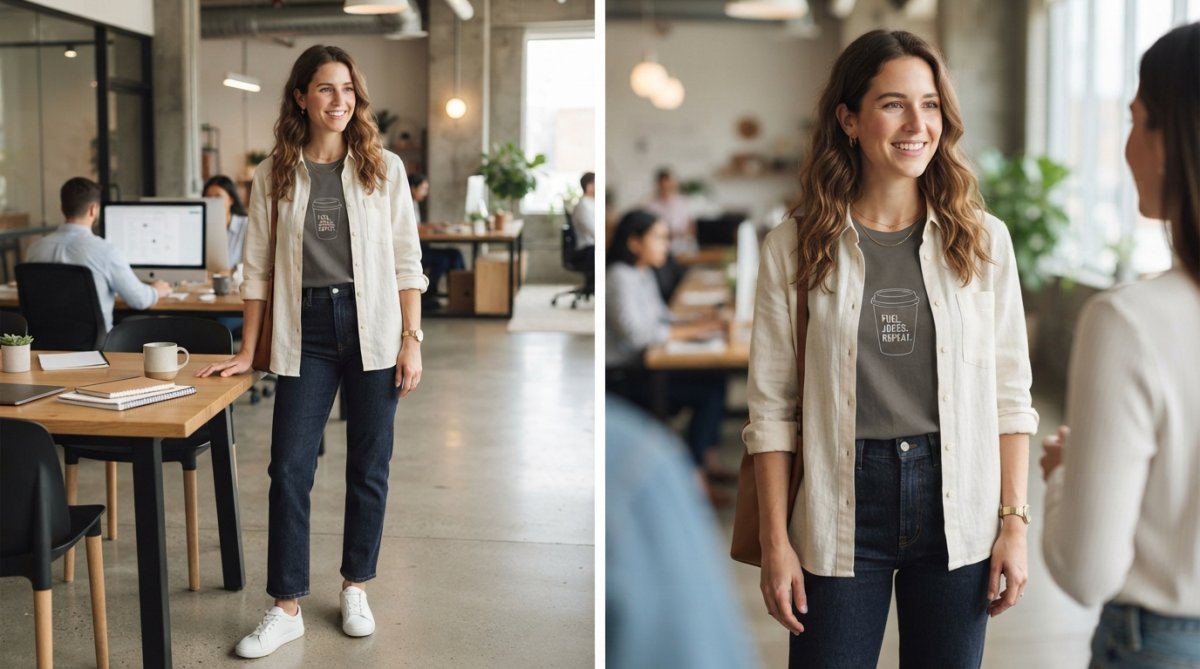
Outfit 5 (Graphic Tee as Layering): Graphic tee (partially visible) under a cream button-up, sleeves rolled, dark jeans, belt, casual shoes. The tee peeks out at the neckline and cuffs. This is a beginner-friendly way to wear a statement piece without it feeling like the whole outfit, the button-up grounds it.
Troubleshooting Common Mix-and-Match Problems
"Everything looks the same." You need more contrast. If your whole outfit is beige and cream, add your accent color, a navy belt, a burgundy shoe, a patterned scarf. One pop of color changes the entire look.
"I look washed out." Your neutrals might not suit your skin tone. If black makes you look tired, swap it for charcoal or navy. If cream looks sallow, try white or ivory instead.
Why Quality Basics Matter for Mixing
Conclusion: Your Capsule Starts Now
Building a minimalist wardrobe capsule isn't about deprivation or looking boring. It's about being intentional with what you own and actually wearing what you buy. Start with neutral basics, choose a color palette that works for you, then add pieces that make you happy, including funny graphic tees that reflect your personality.
Frequently Asked Questions
How many items should a beginner have in a minimalist wardrobe capsule?
Most beginners start with 25-40 pieces total, including tops, bottoms, outerwear, and shoes. This is enough to create 15+ outfit combinations without feeling restrictive. The exact number depends on your lifestyle, someone working from home needs fewer formal pieces than someone in an office. Start with fewer items and add intentionally as you identify gaps.
Can I keep my graphic tees in a minimalist wardrobe capsule?
Absolutely. Graphic tees are perfect for adding personality. Stick to designs that reflect your actual humor and interests. A few well-chosen graphic tees are way more valuable than a dozen forgettable basics.
What is a capsule wardrobe checklist I should follow?
Start with 3-4 neutral tops, 2-3 pairs of bottoms, 1-2 layering pieces, 1 jacket, and 2-3 pairs of shoes. Add 1-2 statement pieces that spark joy, like a fun graphic tee. Include basics like underwear and socks. Then add pieces based on your climate and lifestyle. Use this as a starting framework, not a rigid rule.
Does a minimalist wardrobe mean I have to wear only neutrals?
No. Choose a color palette that works for you, it could be neutrals, jewel tones, pastels, or a mix. Graphic tees, scarves, and accessories add color and personality.