

Table of Contents
- What Sets Heavy and Lightweight Cotton Shirts Apart?
- Breathability and Comfort: Summer Wear vs Winter Base Layer
- The Best Cotton Weight for Graphic Tees
- Durability, Pilling, and How Fabric Weight Affects Longevity
- How to Care for Heavy Cotton Shirts (and Lightweight Ones Too)
- Draping, Silhouette, and Layering Mechanics for Every Body Type
- Environmental Impact and Sustainability in Cotton Shirts
- Conclusion
- Frequently Asked Questions
Last Updated: September 16, 2026
What Sets Heavy and Lightweight Cotton Shirts Apart?
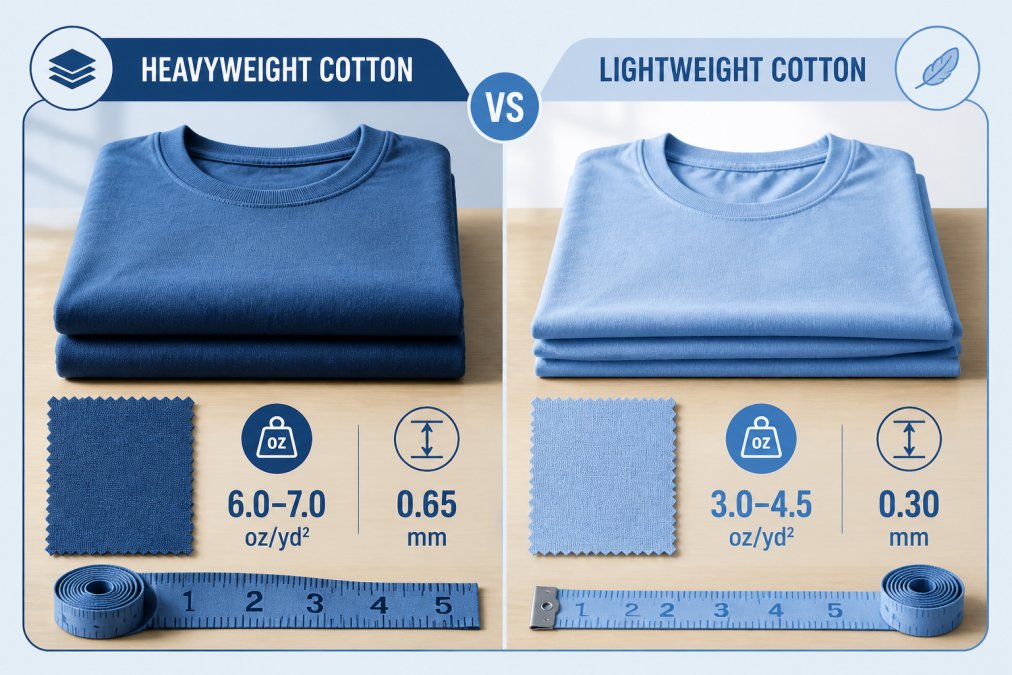
The difference between heavy and lightweight cotton shirts comes down to fabric weight, measured in GSM, and how that density changes everything from breathability to how long your favorite graphic tee survives the wash cycle. At Caltucky Creations, we print jokes on both ends of that spectrum. Heavy cotton gives you structure, opacity, and a print that stays sharp. Lightweight cotton gives you breathability, drape, and broken-in softness from day one. Neither is "better", they're built for different jobs.

GSM: The Number That Tells You Everything
GSM (grams per square meter) is the standard measurement of fabric weight, and it's the fastest way to compare two cotton shirts without touching them. Most heavyweight tees land in the 180-220 GSM range, while lightweight options sit closer to 145-160 GSM. Higher GSM means a denser weave, more opacity, and a sturdier hand-feel. Lower GSM means a thinner fabric that breathes more freely and drapes closer to the body. That single number predicts more about a shirt than any marketing copy ever will.
How Fabric Weight Changes the Feel
Heavy cotton feels substantial the moment you pick it up. It holds its shape on the hanger, resists clinging, and gives off "this will outlast my phone" energy. Lightweight cotton feels like a favorite shirt you've owned for three years, even when it's brand new. It moves with you, layers under a jacket without bulk, and works as a summer staple when the forecast is aggressively unfair.
Breathability and Comfort: Summer Wear vs Winter Base Layer
Lightweight cotton wins summer, heavy cotton wins winter, and the reason is thermal regulation. A thinner weave lets heat and moisture escape, which is why a 150 GSM tee keeps you comfortable in July. A denser weave traps a layer of warm air against your skin, making a 200 GSM shirt an excellent winter base layer under a hoodie or flannel.

Breathability isn't just about temperature, it's about moisture-wicking, which cotton handles through its natural fibers. Lightweight cotton dries faster after a sweaty commute. Heavy cotton absorbs more before it feels damp, making it the better cold-weather layer you're not peeling off at lunch.
The Best Cotton Weight for Graphic Tees
The best cotton weight for graphic tees is 180-220 GSM, because a denser weave holds ink detail and resists the wash-cycle fading that turns a sharp design into a faded rumor. A tightly knit, higher-GSM surface gives the print a stable foundation, so fine lines stay fine and bold colors stay bold. Lightweight cotton can carry a graphic too, but thinner fabric stretches more during printing and washing, softening edges over time. If your design is the whole point of the shirt, heavier is safer.
Why Fabric Density Affects Print Quality
Fabric density determines how much ink sits on the surface versus sinking into the weave. A dense, high-GSM knit keeps more ink on top, so designs on heavy tees look crisper and last longer through repeated washes. On a looser weave, ink spreads slightly, softening detail and reducing contrast. Shrinkage matters too: lower-density fabrics move more in the dryer, and the print moves with them. Pre-shrunk heavy cotton holds its dimensions, keeping your design exactly where it was printed.
Durability, Pilling, and How Fabric Weight Affects Longevity
Heavier cotton generally outlasts lighter cotton because there's simply more fiber to wear through. Tensile strength scales with fabric density, so a 200 GSM shirt resists thinning at the elbows and collar far better than a 150 GSM one. Pilling is a separate issue, tied more to fiber quality than weight: short-staple carded cotton pills faster than long-staple ring-spun or combed cotton, so a lightweight ring-spun tee can resist pilling better than a heavy carded one. When comparing two shirts, check both the GSM and the spinning method.
| Factor | Heavyweight Cotton (180-220 GSM) | Lightweight Cotton (145-160 GSM) |
|---|---|---|
| Breathability | Moderate | High |
| Durability | High tensile strength | Moderate |
| Print sharpness | Excellent | Good |
| Drape and silhouette | Structured | Relaxed, close to body |
| Best season | Fall and winter | Spring and summer |
| Pilling risk | Lower (if ring-spun) | Varies by fiber quality |
How to Care for Heavy Cotton Shirts (and Lightweight Ones Too)
Most care guides stop at "wash cold, dry low" and call it a day. That's fine advice, but it doesn't explain why heavy and lightweight cotton need slightly different handling, or how to keep a printed graphic from cracking in month three. A 200 GSM tee and a 150 GSM tee do not shrink, pill, or fade at the same rate.
The Shrinkage Math Nobody Tells You
Cotton shrinks because fibers relax when wet and contract when dried with heat. The amount depends on how the fabric was finished, how tight the knit is, and how hot your dryer runs.
- Heavyweight cotton (180-220 GSM) is usually pre-shrunk during manufacturing because the denser knit holds its dimensions better. Expect minimal additional shrinkage, often in the low single digits, if you wash cold and dry low. Crank the dryer to high heat and you can still lose noticeable length in the body and sleeves, because heat overrides the pre-shrinking.
- Lightweight cotton (145-160 GSM) has a looser knit, which means more room for the fibers to move. Even pre-shrunk lightweight tees can shrink more than their heavy counterparts under the same conditions, and the effect is most visible in the length. A lightweight tee that fits perfectly on day one can feel a size short after a few hot washes.
The takeaway: the lighter the fabric, the more aggressively you should protect it from heat. Heavy cotton gives you margin for error. Lightweight cotton does not.
A Weight-Specific Care Routine
Here's how to treat each fabric so it lasts:
For heavyweight cotton tees:
- Machine wash cold (max 90F) with similar colors to slow shrinkage and dye loss.
- Turn inside out before washing to protect the print from zippers, buttons, and other garments.
- Tumble dry low, or hang dry to eliminate shrinkage risk. Heavy cotton takes longer to air-dry, so plan for it.
- Skip fabric softener, it leaves a waxy residue that dulls print ink and reduces moisture-wicking.
- Don't iron directly over the print. If you must, turn the shirt inside out or use a thin cloth between iron and print.
For lightweight cotton tees:
- Same cold wash, same inside-out rule, but be gentler with the dryer.
Pilling, Print Cracking, and the Two Mistakes That Kill Shirts
Pilling and print cracking are the two most common ways a cotton tee dies young, and both are more preventable than people think.
The One Habit That Doubles Shirt Lifespan
Want a graphic tee that's built to survive your laundry habits? Caltucky Creations prints original funny designs on both heavyweight and soft-style blanks, so you can pick the fabric weight that matches your care routine, or your complete lack of one. Either way, the punchline holds up.
Draping, Silhouette, and Layering Mechanics for Every Body Type
Drape and silhouette are where fabric weight becomes personal.
Environmental Impact and Sustainability in Cotton Shirts
Fabric weight affects sustainability more than most shoppers realize.
Conclusion
Choosing between heavy and lightweight cotton shirts isn't about finding a winner.
Frequently Asked Questions
Is a 6.1 oz cotton shirt considered heavy?
Yes, 6.1 oz (about 207 GSM) falls into the heavyweight category. Most standard tees sit between 5.0 and 5.5 oz, so 6.1 oz is noticeably thicker and more structured. You will feel the difference in the drape and how it holds its shape after multiple wash cycles. Heavyweight cotton shirts in this range work well for cooler weather and for prints that need a stable surface.
What is a good weight for a cotton t-shirt?
For everyday wear, 5.3 oz (180 GSM) hits the sweet spot between comfort and durability. If you want a shirt for hot summer days, go lighter at 4.5 oz (153 GSM) for better breathability. For graphic tees with detailed prints, a midweight option like 5.3 oz gives the fabric enough density to hold sharp lines without feeling stiff. Your choice depends on climate, layering plans, and how often you wear it.
Does heavy cotton mean 100% cotton?
No. Fabric weight and fiber content are separate things. A heavy cotton shirt can still contain synthetic blends like polyester, which adds durability but changes the hand-feel and moisture-wicking properties. Always check the label. A 5.3 oz shirt made from 100% cotton feels different from a 5.3 oz cotton-poly blend, even though the weight number is the same.
How does fabric weight affect the durability of a graphic print?
Heavier fabrics with a tighter weave give the print a more stable surface, which helps designs resist cracking and fading through repeated wash cycles. Lightweight ring-spun cotton still prints well, but the thinner fabric flexes more, which can stress the ink over time. Cold washing and low-heat drying make a bigger difference than weight alone for keeping any graphic tee looking fresh.