

Table of Contents
- What Makes a Cohesive Aesthetic (And Why It Actually Matters)
- How to Define Your Personal Style Without Overthinking It
- Start With a Color Palette That Doesn't Make Your Eyes Hurt
- Building a Capsule Wardrobe With Graphic Tees as Your Foundation
- Best Accessories for a Cohesive Look That Ties Everything Together
- Texture Layering and Materials: The Secret Weapon Nobody Talks About
- The Psychology of Cohesion: Why Your Brain Loves a Unified Look
- Frequently Asked Questions
Last Updated: September 27, 2026
Styling Tips for a Cohesive Aesthetic
A cohesive aesthetic isn't about having a Pinterest-perfect life. It's about intentionally choosing pieces that work together so your wardrobe actually feels like you, not like you raided five different thrift stores in the dark.
At Caltucky Creations, we've watched people stress over this exact thing: "Will these pieces actually look good together, or am I just buying random stuff?" The good news? Building a cohesive aesthetic is way simpler than you think. It's not about matching everything perfectly. It's about creating visual harmony through intentional choices.
Below, we'll walk you through the exact steps to define your style, build a foundation that works, and tie everything together so your outfits feel genuinely you.
What Makes a Cohesive Aesthetic (And Why It Actually Matters)
A cohesive aesthetic is when your wardrobe or overall vibe feels intentional and unified. Every piece belongs there. Nothing feels random or out of place.
Here's why it matters: when everything works together, your brain relaxes. You're not visually confused. You reach for the same pieces because they pair naturally. Your style feels intentional instead of accidental.
The psychology is real. Unified design reduces mental clutter. When colors, textures, and pieces complement each other, you feel calm. When everything clashes? Your brain works harder to process it. That's exhausting.
Think of it this way: a cohesive aesthetic is the difference between a curated collection and a pile of stuff you happened to buy.
How to Define Your Personal Style Without Overthinking It
Most people overthink this step. They think they need to know their "vibe" before buying anything. Wrong.
Your personal style emerges from what actually makes you happy, not from a mood board you found online. Start by noticing patterns in what you already own and love.
Here's how to figure it out:
- Look at clothes you actually wear (not the ones gathering dust)
- Notice colors that make you feel good
- Pay attention to textures you reach for repeatedly
- Identify the mood you want to create (cozy, bold, minimalist, playful)
Don't force yourself into a category. If you love both minimalist and maximalist vibes, that's your style. Own it.
The secret is this: your personal style should make decisions easier, not harder. Once you know what resonates with you, shopping becomes intentional instead of impulsive.
Start With a Color Palette That Doesn't Make Your Eyes Hurt
A color palette is your foundation. Pick 3-5 colors that feel right to you, and build everything else around them.
Your palette should include:
- 2-3 neutral base colors (think: black, white, gray, beige, cream)
- 1-2 accent colors that excite you (these can be bold or subtle)
- Optional: 1 secondary accent for depth
Here's where most guides stop, and where they miss the real work. Knowing which colors to pick is one thing. Understanding why they work together is another.
The mechanics of color harmony:
Complementary colors (opposites on the color wheel, like navy and mustard, or forest green and coral) create visual excitement. Your eye bounces between them. Analogous colors (neighbors on the wheel, like navy, teal, and green) feel calm and unified. Monochromatic palettes (different shades of one color) feel sophisticated and intentional.
Most cohesive aesthetics use a mix: a neutral base, one complementary accent for pop, and one analogous accent for depth. This prevents the space (or outfit) from feeling either boring or chaotic.
The real-world problem: you probably already own stuff.
If you're building a cohesive aesthetic from scratch, great, pick your palette and move forward. But most people are working with existing pieces that don't match. Here's the honest approach:
-
Audit what you already own. Pull out 5-10 pieces you genuinely love and wear. What colors dominate? Those are your anchors, they're already part of your aesthetic whether you planned it or not.
-
Find the overlap. If you love navy, cream, and forest green across multiple pieces, those are your palette. Don't fight it. Lean into it.
-
Add intentionally from there. New purchases should echo one of those existing colors or introduce a complementary accent that ties back to what you have.
This approach means you're not throwing out half your wardrobe to match a mood board. You're building on what already works for you.
3D Fairy Star Bat Magnetic Keychain →
Testing before you commit:
Before buying a new piece in an unfamiliar color, try it on with what you already own. Lay it next to your existing neutrals and accents. Does it feel like it belongs, or does it feel like a random addition? That gut feeling is your brain recognizing visual harmony (or the lack of it).
The magic happens when these colors work together. Complementary colors feel harmonious. Clashing colors feel chaotic. Once you have your palette, whether it's intentional or discovered from what you already love, every new piece becomes a yes-or-no question. Does it fit the palette? Yes, buy it. No, skip it. This eliminates decision paralysis and keeps your aesthetic from drifting into "I just own a lot of random stuff."
A neutral base keeps everything grounded. Accent colors add personality. Together, they create intentional visual flow throughout your wardrobe.
Building a Capsule Wardrobe With Graphic Tees as Your Foundation
A capsule wardrobe is a small collection of pieces that all work together. Graphic tees are the perfect foundation because they're versatile, fun, and instantly tie an outfit together.
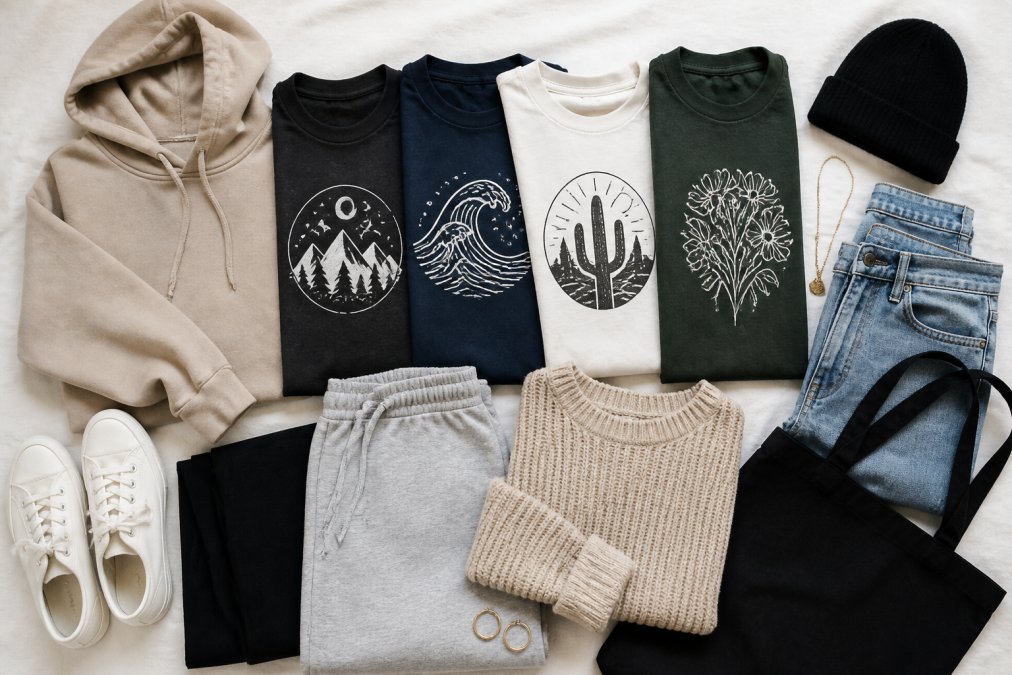
Here's the beauty: a quality graphic tee works with almost anything. Pair it with jeans, layer it under a hoodie, throw it on with sweats. The design carries the outfit.
Start with these essentials:
- 2-3 graphic tees in your accent colors (these are your statement pieces)
- 2-3 neutral basics (solid tees or long sleeves in your base colors)
- 1 hoodie or sweatshirt that ties into your palette
- Jeans or bottoms in neutral tones
- 1-2 layering pieces
Each piece should work with at least 3 other pieces in your capsule. That's the rule. If something only pairs with one item, it doesn't belong.
Caltucky Creations graphic tees are designed to be statement pieces without being loud. The humor lands, the design pops, and the quality means they hold up through dozens of washes. They're the kind of tees that make your capsule actually fun to wear instead of feeling like a uniform.
Best Accessories for a Cohesive Look That Ties Everything Together
Accessories are where cohesion gets interesting. They're the connective tissue between your pieces.
The best accessories for a cohesive look do one of two things: they echo your color palette, or they introduce texture that complements what you already have.
Think about these categories:
- Color-matching accessories: Scarves, bags, or hats in your accent colors
- Texture pieces: Belts, jewelry, or keychains that add visual interest
- Functional accessories: Things you actually use (not just decoration)
A simple magnetic keychain or charm in your accent color ties your everyday carry to your overall aesthetic. It sounds small, but these details create intentional visual flow.

The 3D Fairy Star Bat Magnetic Keychain works because it's quirky without being chaotic.
Texture Layering and Materials: The Secret Weapon Nobody Talks About
Texture is where most people slip up. They focus on color and forget that how something feels matters just as much as how it looks. But here's the thing most guides miss: texture is also how you tie together different categories of stuff, your clothes and your accessories, into one cohesive vibe.
The principle: visual weight and repetition.
Where texture breaks cohesion:
Textures that work together:
- Soft cotton paired with structured denim
- Smooth ceramic with cozy knit
- Matte finishes with subtle (not high-gloss) shine
- Rough linen with soft wool
- Natural wood with soft fabric
Applying this across your whole aesthetic:
- Your graphic tees should be quality cotton (not thin polyester)
- Your hoodie should feel substantial, actual fleece or knit, not cheap synthetic
- Your blanket should be real wool or cotton, not acrylic
- Your mug should be ceramic or stoneware, not glossy porcelain
- Your candle should have a matte finish and natural wax, not plastic-y shine
The Psychology of Cohesion: Why Your Brain Loves a Unified Look
Here's the psychology part: your brain processes visual information constantly. When everything is unified and intentional, your brain uses less energy to process it. That feels good.
Frequently Asked Questions
What does it mean to have a cohesive aesthetic?
A cohesive aesthetic is when your clothing, accessories, and personal style choices feel intentionally connected, like they were picked to work together rather than randomly grabbed. It's about creating visual harmony through consistent colors, materials, and design choices. You don't need everything to match; you just need it to feel like it belongs in the same story. Think of it as your personal style having a through-line that makes sense.
Can you mix and match different styles and still look cohesive?
Absolutely. The key is anchoring your look with a strong color palette and intentional design choices. You can blend casual and dressy, vintage and modern, or playful and minimalist, as long as there's a unifying element like a shared color scheme, material consistency, or design narrative. For example, pairing a graphic tee with tailored pieces works when they share a similar color family or aesthetic energy. Cohesion isn't about uniformity; it's about intentionality.
How do I find my personal style without spending a fortune?
Start by identifying what actually makes you happy when you wear it, not what you think you should like. Pay attention to colors, silhouettes, and vibes that show up repeatedly in pieces you reach for. Build slowly around graphic tees and basics you love, then layer in accessories that feel true to you. Thrift stores, capsule pieces, and affordable accessories let you experiment without breaking the bank. Your personal style doesn't need a designer price tag; it needs intention.
What are the best ways to express personality through clothing and accessories?
Graphic tees are one of the easiest ways, they literally wear your sense of humor and interests. Pair them with accessories that reflect your vibe: magnetic keychains for playful details, caps with attitude, or pieces that hint at your aesthetic. Layer textures and materials that feel authentic to you. The goal is choosing pieces that make you feel like yourself, not pieces that fit a trend. When your clothes tell your story, that's when a cohesive aesthetic actually comes alive.